


Residenzmuseum Munchen - compiled by Hans and 50 similar items
Free Shipping
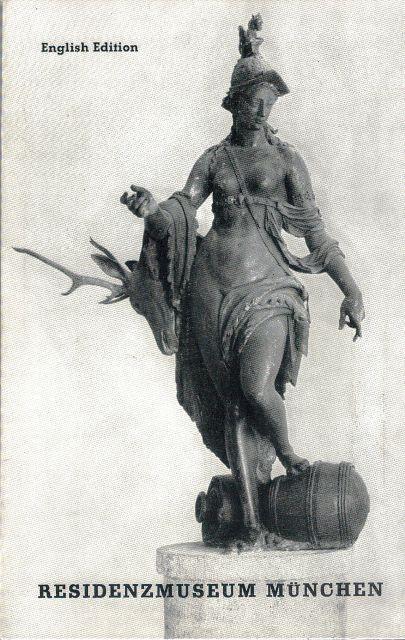
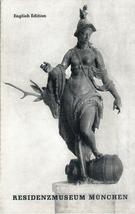
Residenzmuseum Munchen - compiled by Hans Thoma and Herbert Brunner
$18.75
(It may be possible to pay only $16.69 instead of $18.75 when you
use your bCredits at checkout)
Sign up and get $5.00 bCredits free to use at checkout and another $5.00 bCredits when you make your first purchase. More info
Share & earn! Sign in, share this or any listing, and you’ll get commission when it sells.
Learn more

View full item details »
Shipping options
FREE via Unspecified shipping type to United States
Offer policy
OBO - Seller accepts offers on this item.
Details
Return policy
Purchase protection
Payment options
PayPal accepted
PayPal Credit accepted
Venmo accepted
PayPal, MasterCard, Visa, Discover, and American Express accepted
Maestro accepted
Amazon Pay accepted
Nuvei accepted
View full item details »
Shipping options
FREE via Unspecified shipping type to United States
Offer policy
OBO - Seller accepts offers on this item.
Details
Return policy
Purchase protection
Payment options
PayPal accepted
PayPal Credit accepted
Venmo accepted
PayPal, MasterCard, Visa, Discover, and American Express accepted
Maestro accepted
Amazon Pay accepted
Nuvei accepted
Item traits
| Category: | |
|---|---|
| Quantity Available: |
Only one in stock, order soon |
| Condition: |
Very Good |
Listing details
| Shipping discount: |
Seller pays shipping for this item. |
|---|---|
| Posted for sale: |
More than a week ago |
| Item number: |
1562190953 |
Item description
Residenzmuseum Munchen - compiled by Hans Thoma and Herbert Brunner
Publisher: Bayerische Verwaltung der staatlichen schlosser, 1967
English edition
Paperback
5.05 x 7.9 inches, 112 pages plus many pages of pictures
This former royal palace hosts a museum gardens with original interiors royal collections. The Munich Residence has been open to the public as a museum since 1920 and is today one of the most important palace museums in Europe.
------------------
The Hall of Antiquities (Antiquarium), built between 1568 and 1571 for the antique collection of Duke Albert V (1550–1579) by Wilhelm Egkl and Jacobo Strada, is the largest Renaissance hall north of the Alps. It was remodelled into a banqueting hall by Friedrich Sustris in 1586–1600. The Antiquarium housed the Ducal Library until 1581. The low hall was then covered with a barrel vault that had 17 window lunettes. The hall was adorned with paintings by Peter Candid, Antonio Ponzano, and Hans Thonauer the Elder, though some were initially designed by Sustris himself. The Court Chapel (Hofkapelle), the Emperor's Staircase (Kaisertreppe) and Imperial Hall (Kaisersaal), the Stone Rooms (Steinzimmer; 1612–1617; general design by Hans Krumpper) and the Trier Rooms (Trierzimmer); ceiling frescoes by Peter Candid) built for Elector Maximilian I are typical examples from the early 17th century.
The Baroque era is represented by the Papal Rooms (Päpstlichen Zimmer), erected under his son Elector Ferdinand Maria (1651–1679). Pope Pius VI lived here during his visit in Munich in 1782. As a result, the rooms were named after him. The extensions of Elector Maximilian II Emanuel (1679–1726), especially the Alexander room and Summer room are representative living rooms. They were altered not long after his death. The remains were destroyed during the residence fire of 1729.
The Ancestral Gallery (Ahnengallerie; 1726–1731) along with the Porcelain Cabinet (both constructed by Joseph Effner) and the Ornate Rooms (Reichen Zimmer) designed by François de Cuvilliés for Charles Albert (1726–1745) are magnificent examples of the court Rococo style. The rich decoration was executed by Johann Baptist Zimmermann, Joachim Dietrich and Wenzeslaus Miroffsky. The two-storey exterior façade of the Green Gallery (Grüne Gallerie) with its seven arched windows facing the courtyard of the Königsbau is a masterpiece of Cuvilliés. The Green Gallery, named after the wall covering made of green silk damask, was not only a ballroom, but also a gallery for paintings and mirrors. The magnificent Bedchamber (Paradeschlafzimmer) served as the place for the electoral dressing procedure. Thus all the structures erected by the court architects Joseph Effner and François de Cuvilliés served only the glorification of the House of Wittelsbach and the attainment of the imperial crown, which ultimately succeeded in 1742. In January 1745, Charles Albert died as Emperor Charles VII in the Residenz, which was thus also for a short time the imperial palace of the Holy Roman Empire. In the times of Elector Maximilian III (1745–1777) the rococo Apartments of the Prince Elector (Kurfürstenzimmer) were constructed between 1746 and 1763. Cuvilliés and Johann Baptist Gunetzrhainer were responsible for the work.
The Neo-classical epoch is represented by the Charlotte Rooms (Charlottenzimmer), the Royal Apartments and the Halls of the Battles (Schlachtensäle) in the Königsbau. The wall and ceiling paintings are by Julius Schnorr von Carolsfeld in the Nibelungensäle (Nibelungen Halls; 1827–1834). They are the first monumental representations of the Nibelungenlied Nibelungen Saga of Songs. The actual private chambers of the royal couple at the back of the Königsbau no longer survive as they were destroyed in World War II. Leo von Klenze was not only responsible for the architecture, but also designed the floors, the wall paintings and all the furniture. In the Festsaalbau were spacious halls that contained the Grand Throne Room in the centre, the Imperial halls, the ballroom and the Battle Hall in the north-eastern pavilion. These facilities were intended only for state occasions and were only accessible by a grand staircase which no longer exists. Here the most important royal ceremonies were held, surrounded by twelve colossal statues sculpted by Ferdinand von Miller, representing the main Bavarian rulers.
In addition to the rich accumulation of furniture, paintings and sculptures, today the museum contains bronze work, clocks, tapestries, porcelain and several special collections such as masterpieces of bronze art, European miniatures and liturgical vestments. The Wittelsbach dynasty porcelain collection includes items from their own Nymphenburg Porcelain Factory as well as from such famous porcelain producers such as Sèvres in France and Royal Porcelain from Berlin. The Wittelsbach East Asian collection includes over 500 pieces of porcelain and some paintings. In the Royal Silver Chambers, valuable pieces are housed. The collection of relics of the Munich Residenz come from the era of the Counter-Reformation. In the Festsaalbau bronze sculptures from the late 16th and early 17th centuries are presented, one of the richest collections of European bronze art from the Mannerism and early Baroque eras.
|
Why are we showing these items?
Booth
PSU_NittanyLion's booth |

|




-
Refine your browsing experience
We can show you more items that are exactly like the original item, or we can show you items that are similar in spirit. By default we show you a mix.










This item has been added to your cart
 Residenzmuseum Munchen - compiled by Hans Thoma and Herbert Brunner added to cart.
Only one available in stock
Residenzmuseum Munchen - compiled by Hans Thoma and Herbert Brunner added to cart.
Only one available in stock
View Cart or continue shopping.
 Please wait while we finish adding this item to your cart.


Get an item reminder
We'll email you a link to your item now and follow up with a single reminder (if you'd like one). That's it! No spam, no hassle.
Already have an account?
Log in and add this item to your wish list.


