


Ode to Intimations of Immortality and similar items
Free Shipping
10 recent views
Ode to Intimations of Immortality
$19.97
(It may be possible to pay only $17.77 instead of $19.97 when you
use your bCredits at checkout)
Sign up and get $5.00 bCredits free to use at checkout and another $5.00 bCredits when you make your first purchase. More info
Share & earn! Sign in, share this or any listing, and you’ll get commission when it sells.
Learn more

View full item details »

Shipping options
Estimated to arrive by Fri, Apr 10th.
Details
FREE via Standard shipping (1 to 5 business days) to United States
Return policy
Purchase protection
Payment options
PayPal accepted
PayPal Credit accepted
Venmo accepted
PayPal, MasterCard, Visa, Discover, and American Express accepted
Maestro accepted
Amazon Pay accepted
Nuvei accepted
View full item details »
Shipping options
Estimated to arrive by Fri, Apr 10th.
Details
FREE via Standard shipping (1 to 5 business days) to United States
Return policy
Purchase protection
Payment options
PayPal accepted
PayPal Credit accepted
Venmo accepted
PayPal, MasterCard, Visa, Discover, and American Express accepted
Maestro accepted
Amazon Pay accepted
Nuvei accepted
Item traits
| Category: | |
|---|---|
| Quantity Available: |
7 in stock |
| Condition: |
New with tags |
Listing details
| Shipping discount: |
Seller pays shipping for this item. |
|---|---|
| Posted for sale: |
More than a week ago |
| Item number: |
1032312820 |
Item description
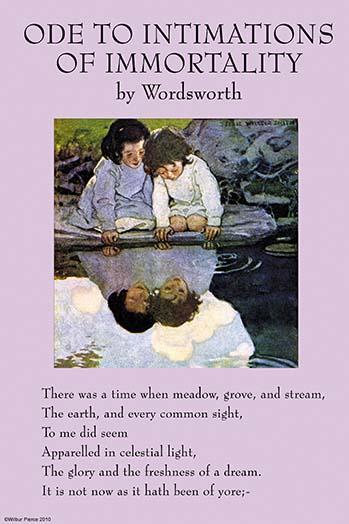
12inch x 18inch Poster Ode: Intimations of Immortality from Recollections of Early Childhood (also known as Ode, Immortality Ode or Great Ode) The poem is an irregular Pindaric ode in 11 stanzas that combines aspects of Coleridge's Conversation poems, the religious sentiments of the Bible and the works of Saint Augustine, and aspects of the elegiac and apocalyptic traditions. It is split into three movements: the first of 4 stanzas discusses concerns about lost vision, the second of 4 stanzas describes how age causes man to lose sight of the divine, and the third of 3 stanzas is hopeful in that the memory of the divine allows us to sympathize with our fellow man. The poem relies on the concept of pre-existence, the idea that the soul existed before the body, to connect children with the ability to witness the divine within nature. As children mature, they become more worldly and lose this divine vision, and the ode reveals Wordsworth's understanding of psychological development that is also found in his poems The Prelude and Tintern Abbey. Wordsworth's praise of children as the "best philosopher" was criticized by Coleridge and became the source of later critical discussion. - There is a border around the image. Image size is correct.
Loading

This item has been added to your cart
 Ode to Intimations of Immortality added to cart.
7 available in stock
Ode to Intimations of Immortality added to cart.
7 available in stock
View Cart or continue shopping.
 Please wait while we finish adding this item to your cart.
Get an item reminder
We'll email you a link to your item now and follow up with a single reminder (if you'd like one). That's it! No spam, no hassle.
Already have an account?
Log in and add this item to your wish list.


